

Connected Dominating Set
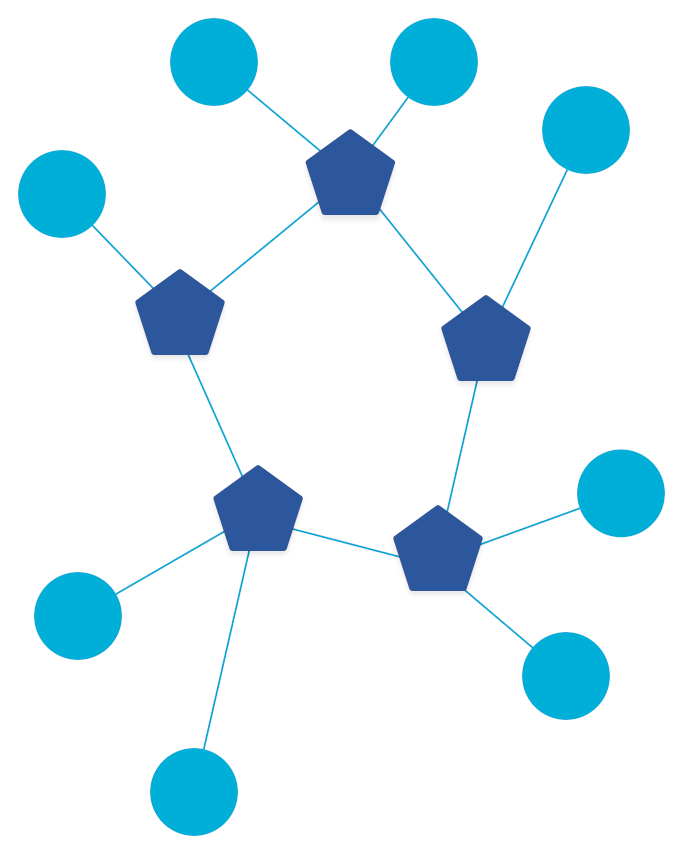
Mesh Extenders must form a Connected Dominating Set (CDS), which means:
- There is a Mesh Extender-only path between any two Mesh Extenders.
- Any one Mesh Extender in a Thread network can reach any other Mesh Extender by staying entirely within the set of Mesh Extenders.
- Every End Device in a Thread network is directly connected to a Mesh Extender.
A distributed algorithm maintains the CDS, which ensures a minimum level of redundancy. Every device initially attaches to the network as an End Device (Child). As the state of the Thread network changes, the algorithm adds or removes Mesh Extenders to maintain the CDS.
Thread adds Mesh Extenders to:
- Increase coverage if the network is below the Mesh Extender threshold of 16
- Increase path diversity
- Maintain a minimum level of redundancy
- Extend connectivity and support more Children
Thread removes Mesh Extenders (switching them to standby Extender-Capable Devices (ECDs)) to:
- Keep the Routing state below the maximum of 32 Mesh Extenders
- Allow new Mesh Extenders in other parts of the network when needed
Upgrade to a Mesh Extender
After attaching to a Thread network, a Child device that is an Extender-Capable Device may elect to become a Mesh Extender. Before initiating the MLE Link Request process, the Child sends an Address Solicit message to the Leader, asking for a Router ID. If the Leader accepts, it responds with a Router ID and the Child upgrades itself to a Mesh Extender.
The MLE Link Request process is then used to establish bi-directional Mesh Extender links with neighboring Mesh Extenders.
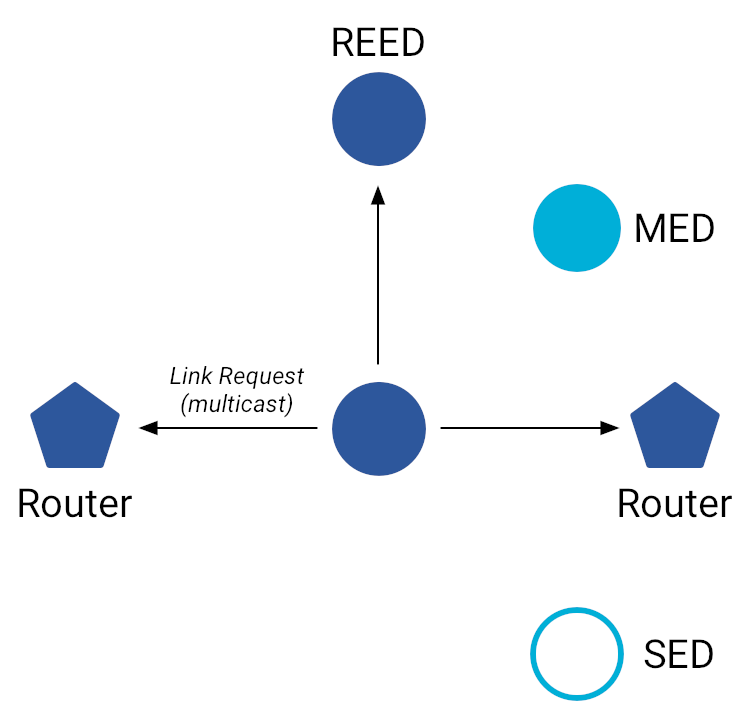
- The new Mesh Extender sends a multicast Link Request to neighboring Mesh Extenders.
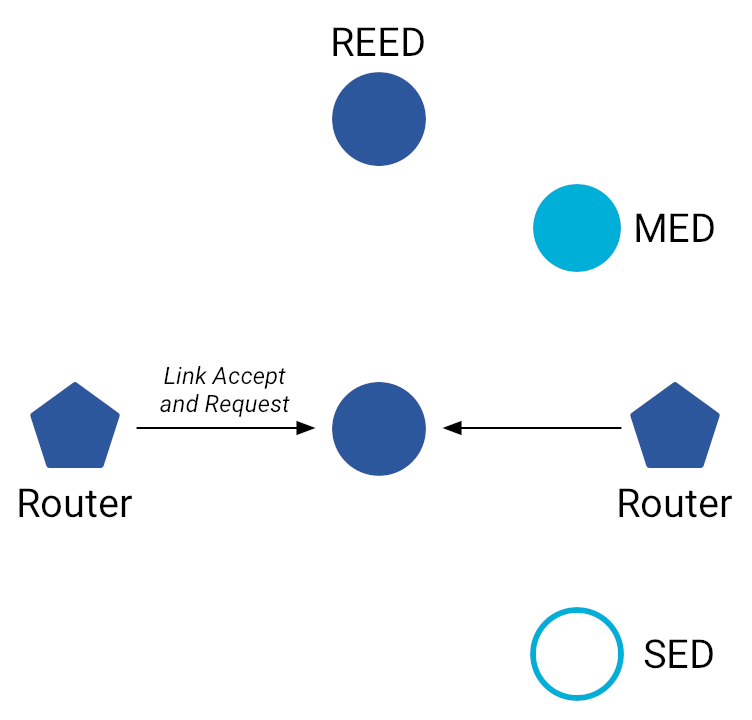
- Mesh Extenders respond with Link Accept and Request messages.
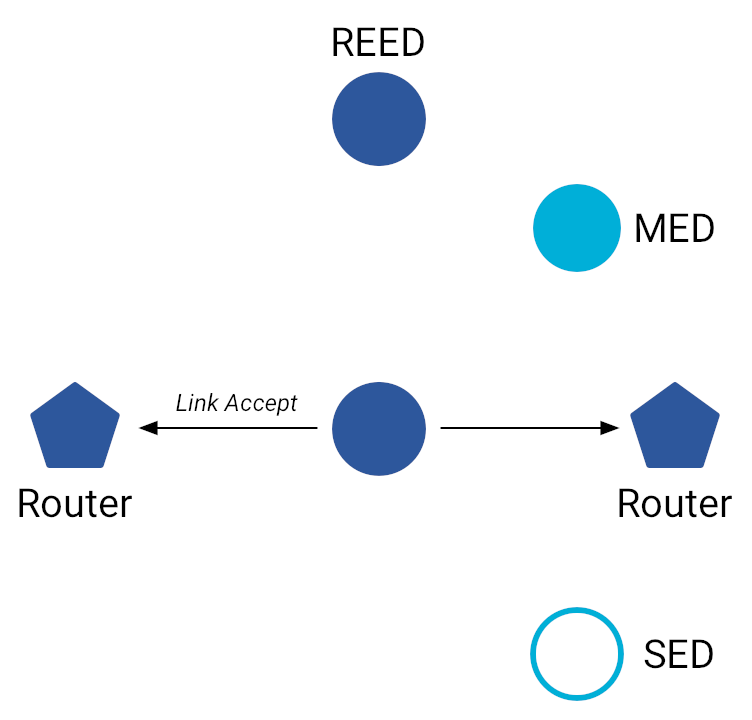
- The new Mesh Extender responds to each Mesh Extender with a unicast Link Accept to establish the Mesh Extender link.
1. Link Request
A Link Request is a request from the Mesh Extender to all other Mesh
Extenders in the Thread network. When first becoming a Mesh Extender,
the device sends a multicast Link Request to ff02::2. Later, after
discovering the other Mesh Extenders via MLE Advertisements, the
devices send unicast Link Requests.
| Link Request Message Contents | |
|---|---|
| Version | Thread protocol version |
| Challenge | Tests the timeliness of the Link Response to prevent replay attacks |
| Source Address | RLOC16 of the sender |
| Leader Data | Information about the Mesh Extender's Leader, as stored on the sender (RLOC, Partition ID, Partition weight) |
2. Link Accept and Request
A Link Accept and Request is a combination of the Link Accept and Link Request messages. Thread uses this optimization in the MLE Link Request process to reduce the number of messages from four to three.
3. Link Accept
A Link Accept is a unicast response to a Link Request from a neighboring Mesh Extender that provides information about itself and accepts the link to the neighboring Mesh Extender.
| Link Accept Message Contents | |
|---|---|
| Version | Thread protocol version |
| Response | Tests the timeliness of the Link Response to prevent replay attacks |
| Link Frame Counter | 802.15.4 Frame Counter on the sender |
| MLE Frame Counter | MLE Frame Counter on the sender |
| Source Address | RLOC16 of the sender |
| Leader Data | Information about the Mesh Extender's Leader, as stored on the sender (RLOC, Partition ID, Partition weight) |
Downgrade to a standby Extender-Capable Device
When a Mesh Extender downgrades to a standby Extender-Capable Device, its Mesh Extender links are disconnected, and the device initiates the MLE Attach process to establish a Child-Parent link.
See Join an existing network for more information on the MLE Attach process.
One-way receive links
In some scenarios, it may be necessary to establish a one-way receive link.
After a Mesh Extender reset, neighboring Mesh Extenders may still have a valid receive link with the reset Mesh Extender. In this case, the reset Mesh Extender sends a Link Request message to re-establish the existing Mesh Extender link.
An End Device may also wish to establish a receive link with neighboring non-Parent Mesh Extenders to improve multicast reliability. We'll learn more about this when we get to Multicast Routing.
Recap
What you've learned:
- Mesh Extenders in a Thread network must form a Connected Dominating Set (CDS)
- Extender-Capable Devices (ECDs) can be upgraded to Mesh Extenders or downgraded to standby ECDs to maintain the CDS
- The MLE Link Request process is used to establish Mesh Extender links